• Home
  • Portfolio
  • My Resume
  • More
    • Home
    • Portfolio
    • My Resume
  • Home
  • Portfolio
  • My Resume

JLR's pivotal

JLR's Pivotal


Pivotal is JLR's vehicle subscription service, allowing customers to access a range of vehicle through flexible monthly subscriptions. Before a customer can begin their subscription, they must complete a series of eligibility checks to verify their identity, driving history, affordability and insurance status. 


As the UX Designer on the project, I worked closely with customers, stakeholders and operational teams to redesign the onboarding experience.

Overview

Problem 🧐

The eligibility process relied heavily on manual intervention from the pivotal team. 


Customers were contacted by email and asked to complete several separate actions before eligibility checks could begin. The process required significant administrative  effort, created delays for customers and increased the risk of drop-off before completion.


The eligibility team was processing appropriately ten applicants per day, spending a considerable time chasing documentation, manually reviewing submissions and progressing customers through the onboarding journey.   


The challenge was to create a more efficient experience that reduced operation overhead while making the process faster and easier for customers. 

Solution 🎯

We identified an opportunity to digitise and automate large parts of the KYC (know your customer) process. 


Rather than relying on email exchanges and manual document verification, customers would complete eligibility checks through a dedicated digital experience that integrated directly with third-party verification providers. 


This would allow customers to complete onboarding more quickly while enabling the business to make legibility decisions faster and at scale. 

Tools ⚒️

  • Lucid
  • Figma
  • Adobe CC Suites
  • JIRA
  • UserZoom
  • Teams

Team 👥

  • 1 UX/UI Designer
  • 4 Developers
  • 1 Project Manager
  • 1 Agile Delivery Lead
  • 1 QA/Tester

Development Lifecycle 🔁

  • Development Lifecycle:  Agile Delivery

My Role 👩🏽‍💻

As the sole UX/UI Designer on the project, I was responsible for:


  • UX Research 
  • User interviews 
  • Journey mapping 
  • Information architecture 
  • Wireframing 
  • UI design 
  • Stakeholder management 
  • Design validation 

My design process

Research & Discovery

Research & Discovery

Research & Discovery

Conducted customer and stakeholder interviews to understand onboarding pain points, operational challenges and opportunities for automation. 

Define Opportunties

Research & Discovery

Research & Discovery

Synthesised research findings to identify key friction points, business requirements and areas where the eligibility journey could be simplified. 

Map the experience

Research & Discovery

Map the experience

Created customer journeys, user flows and information architecture to define a seamless end-to-end onboarding process.

Design & Prototype

Design & Prototype

Map the experience

Produced wireframes and high-fidelity designs to visualise a guided, digital-first eligibility experience. 

Validate & Refine

Design & Prototype

Launch & Optimise

Tested concepts with users and stakeholders, gathering feedback to improve usability, clarity and completion rates. 

Launch & Optimise

Design & Prototype

Launch & Optimise

Supported MVP delivery, monitored performance, and used insights to inform future iterations and onboarding improvements. 

my design process

🧐 Research and Discovery

Before exploring solutions, I wanted to understand both the customer experience and the internal operational process supporting it. 


Customer interviews 


Using UserZoom and Pivotal's customer database, I interviewed:

  • 5 personal customers 
  • 5 business customers 


The objective was to understand:

  • Customer motivations 
  • Perceptions of the Pivotal brand 
  • Experiences during onboarding 
  • Areas of confusion or frustration 


Eligibility team interviews 


I also conducted interviews with members of the legibility team responsible for processing customer applications. These sessions helped uncover:


  • Manual workloads 
  • Process bottlenecks 
  • Common customer issues 
  • Opportunities for automation 


Key Insights 


Several themes emerged during research:


Fragmented experience 

Customers were required to move between multiple channels, creating uncertainty and increasing efforts.


Long processing times 

Delays during verification reduced momentum and increased the risk of customer drop-off.


Lack of visibility 

Customers often didn't understand what stage of the process they were in or what was required next. 


High operational effort 

The eligibility team spent significant time chasing documet

💡 Define Opportunities

Following research, I synthesised findings and identified the highest-value opportunities. The design needed to:


  • Reduce manual processing 
  • Improve completion rates
  • Simplify customer interactions 
  • Increase transparency throughout the journey 
  • Support automated decision making 
  • Create a scalable onboarding process 


These opportunities become the foundation for the future experience.

✍🏼 Map the experience

To better understand how customer progressed through onboarding, I mapped the existing and future state journeys. This included:


Customer journey mapping 

Understanding customer emotions, actions and pain points throughout the process. 


User flows

Defining how customers would navigate between eligibility steps and verification checks.


Information Architecture 

Structuring content and interactions to create a more intuitive onboarding experience.


By visualising the entire journey, I was able to identify areas where friction could be removed and interactions simplified. 

👩🏽‍🎨 Design & Prototype

Using insights from discovery and journey mapping, I created wireframes and high-fidelity prototypes to explore potential solutions. The redesign experience focused on:


Guided progression

Breaking  

🔄 Iteration & Feedback

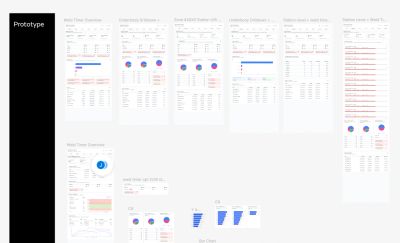
Wireframes and concepts were reviewed regularly with stakeholders and users. Feedback session helped validate:


  • Navigation structures 
  • Dashboard layouts
  • KPI prioritisation 
  • Alert presentation 
  • Drill-down journeys 


This iterative approach ensured designs remained aligned with operational needs while balancing technical constraints. 

The outcome

Outcome

The resulting experience provided a clearer and more scalable foundation for manufacturing monitoring and predictive maintenance. The platform enabled users to:


  • Monitor equipment health more effectively 
  • Identify issues faster 
  • Navigate complex manufacturing data more efficiently
  • Access information at the appropriate level of detail


The work also established a design framework that could be reused across future equipment dashboards and manufacturing use cases. 

Reflection

This project strengthened my ability to design within highly complex enterprise environments. 


The biggest lesson was that successful dashboard design is rarely about displaying more data. It's about helping users understand what matters when it matters and giving them the confidence to act on it. 


By investing time in discovery and understanding the manufacturing domain, I was able to move beyond designing dashboards and instead design experiences that supported real operational decision-making. 

Contact Me

Need a UX designer? Get in touch!

LinkedIn: https://www.linkedin.com/in/jasleen-sura-abc123/ E-Mail: Jasleen_sura@hotmailoc.uk Phone: 07778881250

Get in Touch!

Attach Files
Attachments (0)

This site is protected by reCAPTCHA and the Google Privacy Policy and Terms of Service apply.

Cancel
  • Resume PDF

JUX Design

E-Mail: jasleen_sura@hotmail.co.uk

Copyright © 2026 JUX Design  - All Rights Reserved.

Powered by

This website uses cookies.

We use cookies to analyze website traffic and optimize your website experience. By accepting our use of cookies, your data will be aggregated with all other user data.

DeclineAccept